Description
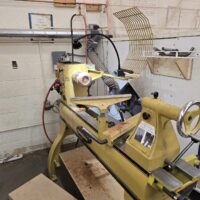
A wood lathe is a stationary woodworking machine used to shape material by rotating it around a horizontal axis while cutting tools are applied by hand. Lathes are used to produce round, cylindrical, and symmetrical forms, making them essential for woodturning operations.
Our shop has two primary types of wood lathes:
Full-Size Wood Lathes
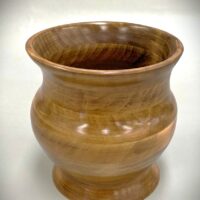
These are large, heavy-duty machines capable of turning workpieces up to approximately 18 inches in diameter and 3–4 feet in length. They are designed for bowls, platters, table legs, spindles, and other large or heavy turning projects. Their mass and power provide stability when working with larger blanks, but also require careful setup and disciplined technique. Training is required.
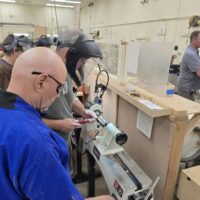
Pen Lathes
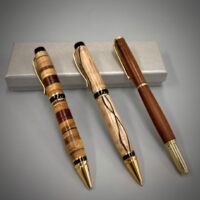
Pen lathes are small, precision lathes designed for turning narrow, lightweight stock. They are commonly used for pens, small spindles, and other fine detail work. While less powerful, pen lathes allow for controlled, accurate turning on small projects.
Regardless of size, all lathes operate on the same fundamental principle: the workpiece spins, and the tool remains stationary in the operator’s hands. Because the cutting tool is guided manually, safe operation depends heavily on proper technique, correct tool selection, secure mounting of the workpiece, and constant attention by the operator.
When used correctly, wood lathes are versatile and rewarding machines. When misused, especially with large or unbalanced stock, they can present serious hazards—making training, proper setup, and respect for the machine essential.
⚠️ Warnings
Training required for lathes. Only trained and authorized members may operate the full-size wood lathes. Large, heavy workpieces create forces that can cause serious injury if proper techniques are not followed. The operator is not the only one at risk.
Work-piece ejection hazard. Improperly mounted, unbalanced, or cracked stock can break loose and be thrown from the lathe at high speed. Always verify secure mounting and correct speed before starting the machine.
All lathes require safety glasses and face-shield to be worn any time the wood is spinning. Your face is more valuable than your comfort!
Failure to clean the lathe and surrounding area may result in disciplinary action. Lathe work is messy, please clean up the effected area.
Usage Instructions
- Use the correct lathe for the project. Large blanks and bowls must be turned on full-size lathes; pen lathes are for small, lightweight work only.
- Training required for large lathes. Verify you are authorized before operating full-size machines.
- Inspect the lathe before use. Ensure guards are in place, controls operate correctly, and the area is clear.
- Inspect the workpiece. Check for cracks, defects, or loose components before mounting.
- Mount the workpiece securely. Use the appropriate faceplate, chuck, centers, or mandrel for the project.
- Adjust the tool rest properly. Position it close to the workpiece and lock it securely before starting.
- Rotate the workpiece by hand to confirm clearance before turning on the lathe.
- Set the correct speed. Start at the lowest appropriate speed, especially with large or unbalanced stock.
- Wear required PPE: Safety glasses and face shield are required; hearing protection is recommended.
- Stand clear when starting. Position yourself out of the line of fire when powering on the lathe.
- Use sharp, appropriate turning tools and maintain firm control with both hands.
- Make light, controlled cuts. Do not force the tool into the workpiece.
- Stop the lathe before adjustments. Never adjust the tool rest, speed, or mounting while the lathe is running.
- Turn off the lathe and wait for a complete stop before leaving the machine or removing the workpiece.
Cleaning
- Remove wood chips and shavings from the bed, tool rest, headstock, tailstock, and surrounding area using a brush or vacuum.
- Clear debris from the motor and control areas without disturbing guards or covers.
- Clean the tool rest and banjo to remove pitch or residue that could affect tool movement.
- Inspect the lathe bed rails and wipe them clean to ensure smooth tailstock and banjo movement.
- Sweep the floor around the lathe to remove shavings and reduce slip hazards.
- Return tools, chucks, and accessories to their designated storage locations.
- Leave the lathe and area clean and safe for the next user
Safety Issues
- Work-piece ejection Improperly mounted, cracked, or unbalanced stock can break loose and be thrown from the lathe at high speed.
- Large mass and inertia (full-size lathes) Heavy workpieces store significant energy and can cause severe injury if they fail or shift.
- Tool catch Incorrect tool angle, dull tools, or aggressive cuts can cause the tool to catch and be violently pulled from the operator’s hands.
- Entanglement hazard Loose clothing, gloves, jewelry, or long hair can be caught by the rotating workpiece.
- Improper speed selection Starting at too high a speed increases the risk of vibration, loss of control, or workpiece failure.
- Tool rest adjustment Adjusting the tool rest while the lathe is running can result in sudden tool contact or loss of control.
- Standing in the line of fire Starting the lathe while standing directly in front of the rotating workpiece increases injury risk.
- Flying debris Chips, bark, knots, or broken pieces can be ejected during turning operations.
- False sense of control (pen lathes) Smaller workpieces may appear safer but still pose blade, entanglement, and tool-catch risks.
- Inattention and fatigue Continuous manual tool control requires focus; distraction increases the likelihood of accidents.
Safety glasses and face shield are required
Jim C
Required PPE should read “Safety glasses and face shield are required