Description
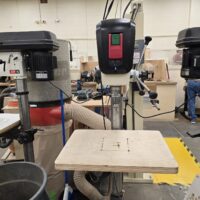
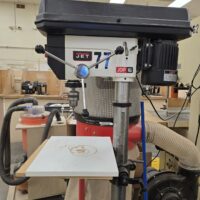
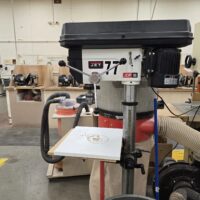
A drill press is a stationary woodworking machine designed to drill accurate, straight, and repeatable holes in wood and other approved materials. Unlike hand-held drills, a drill press provides precise control over hole location, depth, and angle, making it an essential tool in a woodshop.
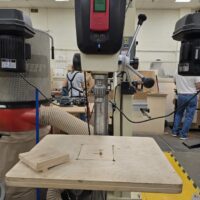
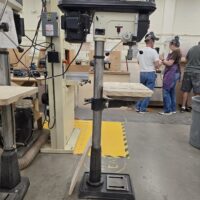
The machine consists of a heavy base, vertical column, adjustable table, spindle, and motor-driven chuck. Material is positioned on the table and held securely while the operator lowers the rotating drill bit into the workpiece using a feed handle. Many drill presses include adjustable depth stops to ensure consistent hole depth across multiple parts.
Drill presses are commonly used for boring holes, counterboring, countersinking, and drilling at precise angles when properly set up. Their rigidity and controlled feed improve accuracy, reduce bit wandering, and produce cleaner results than hand-held drilling.
When used correctly, a drill press is one of the safest and most precise machines in the shop. Proper setup, secure work holding, and correct speed selection are essential to safe and effective operation.
⚠️ Warnings
Secure all workpieces. Never hold material by hand while drilling. Workpieces must be clamped or otherwise restrained to prevent spinning, lifting, or ejection.
Entanglement hazard. Loose clothing, gloves, jewelry, long hair, or rags can be caught by the rotating spindle or bit and cause serious injury.
Failure to clean the machine and surrounding area may result in disciplinary action. Vacuums, brooms and dust pans are located throughout the shop for your use.
Usage Instructions
- Inspect the drill press before use. Ensure the bit is sharp, properly installed, and securely tightened in the chuck.
- Select the correct speed for the drill bit size and material being drilled.
- Wear required PPE. Safety glasses are required; hearing protection is recommended.
- Secure the workpiece. Clamp material firmly to the table or use an approved vise—never hold work by hand.
- Adjust the table and depth stop as needed for the operation.
- Align the workpiece and bit before starting the machine.
- Start the drill press and allow it to reach full speed before drilling.
- Feed the bit smoothly and under control. Do not force the cut.
- Clear chips safely. Stop the machine before removing chips or making adjustments.
- Turn off the drill press and wait for a complete stop before removing the workpiece or leaving the machine.
Cleaning
- Remove wood chips and debris from the table, base, and surrounding area using a brush or vacuum.
- Clear chips from the chuck and bit area with a brush—never by hand.
- Inspect and clean the slots in the table to ensure clamps and vises seat properly.
- Check the floor around the drill press and sweep up chips and debris.
- Return clamps, vises, and accessories to their proper storage locations.
- Leave the drill press and area clean and safe for the next user.
Safety Issues
- Spinning workpiece hazard Unsecured material can spin violently if the bit catches, causing serious injury.
- Entanglement risk Loose clothing, gloves, jewelry, long hair, or rags can be caught by the rotating spindle or bit.
- Flying debris Wood chips, broken bits, or loose material can be ejected during drilling.
- Bit breakage Dull, damaged, or improperly installed bits can snap under load.
- Improper speed selection Using the wrong spindle speed increases the risk of bit breakage and poor control.
- Hand placement Hands placed too close to the rotating bit can be pulled into the cutting area.
- Clearing chips unsafely Removing chips while the machine is running can result in cuts or entanglement.
- Coasting spindle The spindle continues to rotate briefly after the machine is turned off.