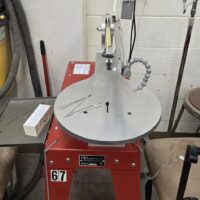
Description
A scroll saw is a stationary woodworking machine designed for fine, detailed, and intricate cutting. It uses a thin, vertically reciprocating blade that moves up and down through a small opening in the table, allowing for precise control and tight cutting radii.
Scroll saws are particularly well suited for decorative work, including curved patterns, fretwork, and interior cutouts. The narrow blade can be threaded through a drilled hole in the workpiece, making it possible to cut shapes completely inside a panel—something not achievable with most other saws.
Because the blade cuts with minimal force and at a controlled speed, scroll saws excel at small, thin, and delicate stock. They are not intended for thick material, heavy stock removal, or long straight cuts.
When used correctly, a scroll saw provides exceptional accuracy and control, making it an ideal tool for detailed woodworking projects where precision is more important than cutting speed.
⚠️ Warnings
Blade contact hazard: The blade is exposed above the table and can cause serious injury. Keep fingers clear of the blade path at all times.
False sense of safety: Scroll saws cut slowly and quietly, which can lead to complacency. Never assume the saw is harmless.
These saws are located in our assembly room and keeping the area clean is a high priority. Clean up or face disciplinary action.
Usage Instructions
- Inspect the saw before use. Ensure the blade is properly installed, correctly tensioned, and securely clamped.
- Select the correct blade for the material thickness and type of cut.
- Wear required PPE. Safety glasses are required; hearing protection is recommended.
- Inspect the material. Ensure wood is clean, dry, and free of nails, screws, or embedded debris.
- Adjust the hold-down or guard (if equipped) so it lightly contacts the workpiece.
- Position the workpiece flat on the table and keep it fully supported.
- Start the saw and allow it to reach full speed before beginning the cut.
- Guide the material slowly and smoothly. Let the blade cut at its own pace—do not force the workpiece.
- Use relief cuts when making tight curves to prevent blade twisting or breakage.
- Keep fingers clear of the blade path and maintain safe hand placement at all times.
- For interior cuts, turn off the saw, allow the blade to stop, thread the blade through the workpiece, and re-tension before restarting.
- Turn off the saw and wait for a complete stop before removing material, changing blades, or making adjustments.
Cleaning
- Turn off the saw and wait for the blade to stop completely before cleaning.
- Clear the table surface of sawdust, cutoffs, and debris.
- Brush or vacuum sawdust from the blade area, hold-down, and guards.
- Clean sawdust from the lower cabinet or base if equipped.
- Sweep the floor around the saw to remove sawdust and debris.
- Leave the saw and area clean and safe for the next user.
Safety Issues
- Exposed blade hazard The thin reciprocating blade is exposed above the table and can cause serious injury.
- Small workpiece control Small or narrow pieces can shift unexpectedly, bringing fingers too close to the blade.
- Blade breakage Forcing the cut, twisting the workpiece, or using the wrong blade can cause the blade to break.
- Flying debris Broken blade fragments or small cutoffs may be ejected during cutting.
- Hand positioning Poor hand placement increases the risk of blade contact.
- Coasting blade The blade continues moving briefly after the saw is turned off.
- Loose clothing and entanglement Sleeves, gloves, jewelry, or long hair can be caught by the moving blade.
- Interior cut setup Threading and re-tensioning blades increases exposure to the blade.
- Material defects Nails, screws, or embedded debris can damage the blade or cause breakage.
- Complacency risk Quiet operation and fine blades can lead to underestimating the hazard.
Scroll saws do not have dust extraction. #4653