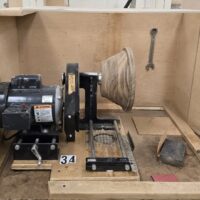
Description
A Ring Bowl Machine is a specialized woodworking machine designed to produce precise circular rings used in segmented and ring-constructed bowls. Rather than turning a solid blank, this machine allows bowls to be built from stacked wooden rings that are later glued and turned to final shape.
The Ring Bowl Machine uses a rotating cutting system to accurately cut concentric rings from flat stock or laminated panels. Each ring is cut to a consistent thickness and diameter, ensuring uniformity and alignment when the rings are stacked. This method allows for greater control over bowl size, wall thickness, and design, while also enabling the use of decorative lamination or contrasting woods.
Because the machine performs controlled, repeatable circular cuts, it is especially useful for creating large or complex bowls that would be difficult or inefficient to produce from a single solid blank. The resulting ring stacks are typically finished either on a lathe or back on the Ring Bowl Machine after assembly.
Although the Ring Bowl Machine automates part of the bowl-forming process, it involves exposed cutters and rotating components. Proper setup, careful operation, and adherence to shop procedures are essential for safe and successful use. Training by taking the Ring Bowl class is highly recommended. Sign up here.
⚠️ Warnings
Secure mounting is critical. Improperly mounted or unbalanced material can shift, loosen, or be ejected during rotation, causing serious injury or machine damage.
Entanglement risk. Loose clothing, gloves, jewelry, or long hair can be caught by the rotating material and pull the operator toward the cutters.
Training by taking the Ring Bowl class is highly recommended. Sign up here.
Usage Instructions
- Inspect the machine before use. Ensure cutters are sharp, secure, and guards are in place.
- Wear required PPE. Safety glasses are required; hearing protection is recommended.
- Inspect the stock. Ensure material is flat, stable, and free of nails, screws, or embedded debris.
- Secure the workpiece firmly according to machine setup procedures.
- Set ring diameter and thickness before starting the machine. Lock all adjustments securely.
- Confirm cutter clearance by manually rotating or positioning the workpiece before powering on.
- Open vacuum gate prior to cutting operation.
- Start the machine and allow it to reach full speed before engaging the cut.
- Feed the cutter smoothly and under control. Do not force the cut.
- After cutting in one direction add tape to prevent the cut off part from being full ejected when cutting from the other direction.
- Complete the cut fully and stop the machine before removing the cut off ring.
- Turn off the machine and wait for all motion to stop before adjustments or cleanup.
- Close vacuum gate when finished with the machine.
Cleaning
- Remove ring cut offs and debris from the cutting area and table.
- Brush or vacuum sawdust and chips from cutters, guards, and surrounding surfaces.
- Inspect cutter area for pitch or resin buildup and report excessive buildup to maintenance.
- Clear dust from adjustment mechanisms to ensure accurate future setups.
- Sweep the floor around the machine to remove debris and reduce slip hazards.
- Return tools, fixtures, and accessories to their designated storage locations.
- Leave the machine and area clean and safe for the next user.
Safety Issues
- Rotating workpiece hazard The spinning material is the primary danger. Contact with the rotating stock can cause severe injury instantly.
- Work-piece ejection Improperly mounted, unbalanced, or cracked material can loosen or be thrown from the rotating fixture at high speed.
- Entanglement risk Loose clothing, gloves, jewelry, or long hair can be caught by the rotating material and pull the operator toward the cutter.
- Hand placement danger Hands placed too close to the rotating workpiece can be drawn into the cutting zone before there is time to react.
- Fixed cutter exposure Although stationary, the cutter is sharp and dangerous. Contact during rotation or cleanup can cause serious injury.
- Imbalance and vibration Uneven stock or poor mounting can cause vibration, loss of control, or sudden failure.
- False sense of safety Because the cutter does not move, operators may underestimate the danger posed by the rotating material.
- Flying debris Chips, fragments, or broken material can be ejected during cutting.
- Cleanup and adjustment hazards Reaching into the machine before the workpiece has completely stopped can result in injury.
- Inattention and fatigue Continuous rotation can lead to complacency; loss of focus significantly increases risk.
The ring bowl machine finishing process , 3rd paragraph should have the word “or” after the word “lathe”
Add “open vacuum gate before cutting operation and also add the same note at the end of the process, to “close vacuum gate”