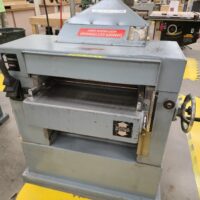
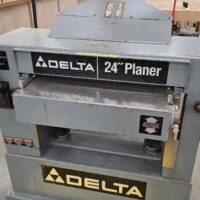
Description
A stationary planer is a precision woodworking machine used to reduce lumber to a uniform thickness and produce smooth, parallel surfaces. It is an essential piece of equipment in a woodshop and is commonly used after jointing to dimension rough stock accurately.
The planer consists of a heavy base, a rotating cutterhead fitted with knives or carbide inserts, powered feed rollers, and an adjustable thickness control. Lumber is fed through the machine with the previously flattened face down, allowing the cutterhead to remove small amounts of material from the top surface. This process creates boards that are consistent in thickness, flat, and ready for further machining or joinery operations.
⚠️ Warnings
This planer is intended for solid hardwood only. Plywood and other manufactured materials are prohibited, as they may splinter and clog the dust system. Inspect all wood to ensure it is clean and free of metal. This machine is not designed to remove finishes. Failure to properly clean the machine and surrounding area may result in disciplinary action.
Usage Instructions
- Wear required personal protective equipment, including safety glasses.
- Inspect wood to ensure it is clean, dry, and free of metal or foreign objects.
- Verify the dust collection valve is open.
- Set the planer for a light cut only. Max is one full turn.
- Place the board flat on the infeed table.
- Stand to the side of the board, not directly behind it.
- Allow the feed rollers to pull the board through the machine.
- Do not push, pull, or force the material.
- Make multiple light passes to reach the desired thickness.
- Turn off the machine and wait for all moving parts to stop before leaving the area.
Cleaning
- Remove wood chips and dust from the infeed table, outfeed table, bed, and surrounding areas using a brush or vacuum.
- Do not use hands to clear debris near openings or moving parts.
- Verify the dust collection system valve is shut.
- Remove all scrap wood from the machine and nearby surfaces.
- Sweep the floor around the planer and dispose of debris properly.
- Leave the area clean and safe for the next user.
Safety Issues
- Contact with the rotating cutterhead can cause serious injury. Hands or fingers can be pulled into the infeed opening if placed too close.
- Reaching into the planer while it is running is extremely dangerous.
- Improper feeding, excessive cutting depth, or damaged wood can cause boards to be forcefully ejected.
- Knots, cracks, or foreign objects may break loose and become projectiles.
- Standing directly behind the board increases the risk of injury from kickback.
- Loose clothing, gloves, jewelry, or long hair can become caught in the feed rollers and pull the operator toward the cutterhead.
- Nails, screws, staples, or embedded debris can damage the machine and be ejected at high speed.
- Wet, warped, twisted, or unstable boards may feed unpredictably and cause loss of control.