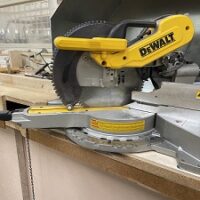
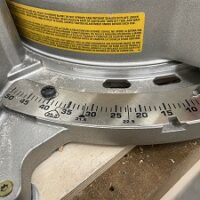
Description
Our shop is equipped with two DeWalt compound miter saws, one featuring a sliding radial arm with approximately 10 inches of cutting travel. The second saw is a basic miter saw without radial travel. These saws are precision machines designed for making accurate crosscuts, miter cuts, and bevel cuts in solid lumber and dimensional stock.
The compound miter saw combines three cutting motions:
- Vertical blade travel for crosscutting
- Miter rotation for angled cuts across the width of the board
- Bevel tilt for angled cuts through the thickness of the material
The sliding radial arm allows the blade to travel forward and backward, significantly increasing cutting capacity and enabling wider boards to be cut accurately in a single pass.
These saws are ideal for cutting material to length, producing precise angles for frames, trim, and joinery, and making repeatable cuts when used with stops or fences. While highly accurate for crosscutting and angled work, compound miter saws are not intended for ripping or freehand cutting.
When properly set up and used, DeWalt compound miter saws provide fast, repeatable, and accurate cuts, making them an essential tool for material preparation and project assembly in the shop.
⚠️ Warnings
This is an open saw blade with no safety stop. Always keep hands clear of the blade. Use clamps to hold wood in place when needed.
Failure to clean up after using this saw may result in disciplinary action.
Usage Instructions
For Smaller Boards (the blade covers the entire width)
- Push the saw head fully back (toward the fence).
- Start the saw and allow the blade to reach full speed.
- Lower the blade into the workpiece.
- NOTE: There is no radial movement of the saw head.
- Hold the saw head down until the blade comes to a complete stop, then raise it
For Larger Boards
- Pull the saw head fully forward toward you (away from the fence).
- Start the saw and allow the blade to reach full speed.
- Lower the blade into the near edge of the workpiece.
- Push the saw head back toward the fence to complete the cut.
- Hold the saw head down until the blade comes to a complete stop, then raise it.
Cleaning
- Turn off the saw and wait for the blade to stop completely before cleaning.
- Clear the table and fence of sawdust, chips, and offcuts.
- Remove scrap material from the surrounding work area.
- Inspect the dust collection intake and ensure it is clear and not clogged.
- Brush or vacuum sawdust from guards, rails, and sliding mechanisms.
- Sweep the floor around the saw to remove sawdust and debris.
- Leave the saw and area clean and safe for the next user.
Safety Issues
- Blade climb and sudden movement Starting a cut incorrectly can cause the saw head to surge or bind.
- Flying wood and debris Offcuts, knots, or loose material can be ejected at high speed.
- Hand placement hazards Hands placed inside the safe zones or near the blade path risk serious injury.
- Coasting blade The blade continues spinning after the trigger is released and remains dangerous.
- Material shift or lift Improperly supported or unsecured stock can move during cutting.
- Pinch and crush points The sliding rails and pivot points can pinch fingers during operation or setup.
- Loose clothing and entanglement Sleeves, gloves, jewelry, or hair can be caught by the blade or moving parts.
- Improper cuts Ripping, freehand cutting, or cutting unsuitable materials can cause loss of control.
- Unexpected startup Failure to disconnect power or use lockout features during adjustments can lead to unintended blade movement.
- Noise and dust exposure Prolonged use can cause hearing damage or respiratory irritation without proper protection.
One saw is a basic miter saw while the other is a sliding miter saw. #4653