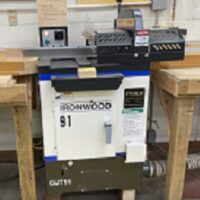
Description
An Ironwood Cut-Off Saw is a heavy-duty industrial woodworking machine designed for making accurate crosscuts in solid lumber and sheet stock. It is commonly used for trimming material to rough or finished length prior to further machining operations.
The saw features a robust steel frame, a powerful motor, and a vertically mounted circular blade that is brought down through the workpiece in a controlled motion. Material is supported on a flat table or conveyor surface and positioned against an adjustable fence or stop system to ensure repeatable, square cuts. The Ironwood cut-off saw is equipped with an automatic mechanical hold-downs to secure the workpiece during cutting, improving accuracy and safety.
Built for continuous use in industrial environments, the Ironwood cut-off saw provides fast, consistent, and precise crosscutting for production work, batch processing, and material preparation in a professional woodshop.
⚠️ Warnings
Follow the directions and place “BOTH” hands on the actuating buttons when operating this machine. As with any machine usage, be sure to remove all cut pieces and clean up the area after use.
Usage Instructions
- Inspect the machine before use. Ensure guards are in place, the blade is sharp and secure, and dust collection is operating properly.
- Verify material is safe to cut. Inspect wood for nails, screws, staples, knots, or cracks, and use only clean, approved material.
- Set fences and stops before cutting. Adjust length stops and fences securely and never make adjustments while the blade is moving.
- Position the workpiece correctly. Place material flat on the table and firmly against the fence for accurate, square cuts.
- Securing the material is automated. When triggering the saw by pushing the buttons the piece will be firmly held in place by the machine.
- Place both hands on the two red buttons to trigger the saw. Again the lowering of the blade and clamping the material is all automatic.
- Allow the blade to stop completely. Wait for the blade to come to a full stop before raising it or removing the workpiece.
- Turn off the machine before leaving. Power down the saw and wait for all moving parts to stop before leaving the area.
Cleaning
- Turn off the machine and wait until the cutterhead has come to a complete stop.
- Remove chips and dust from the tables, fence, and base using a brush or vacuum—do not use hands or compressed air.
- Return the fence and guard to their neutral or storage positions.
- Leave the area clean and safe for the next user. This includes the floor area around the machine.
Safety Issues
- Ejected material Short offcuts, loose knots, or defects in the wood can be ejected from the outfeed area at high speed, even when the blade is enclosed.
- Improper material support Long or heavy stock not properly supported on infeed or outfeed tables can tip, bind, or shift during the cut. Be sure the wood is tight against the back fence.
- Material defects Hidden cracks, knots, or internal stress can cause the material to break suddenly during cutting.
- Bypassing safety systems Defeating guards, sensors, or two-hand controls creates a severe injury risk and is strictly prohibited.
- Maintenance and clearing jams Blade changes, clearing jams, or servicing the saw expose operators to cutting and pinch hazards if proper lockout/tagout procedures are not followed.
- Noise exposure Industrial cut-off saws can produce high noise levels during operation.
- Dust and debris accumulation Wood dust buildup can affect visibility, create slip hazards, and reduce dust-collection effectiveness if not properly managed.